
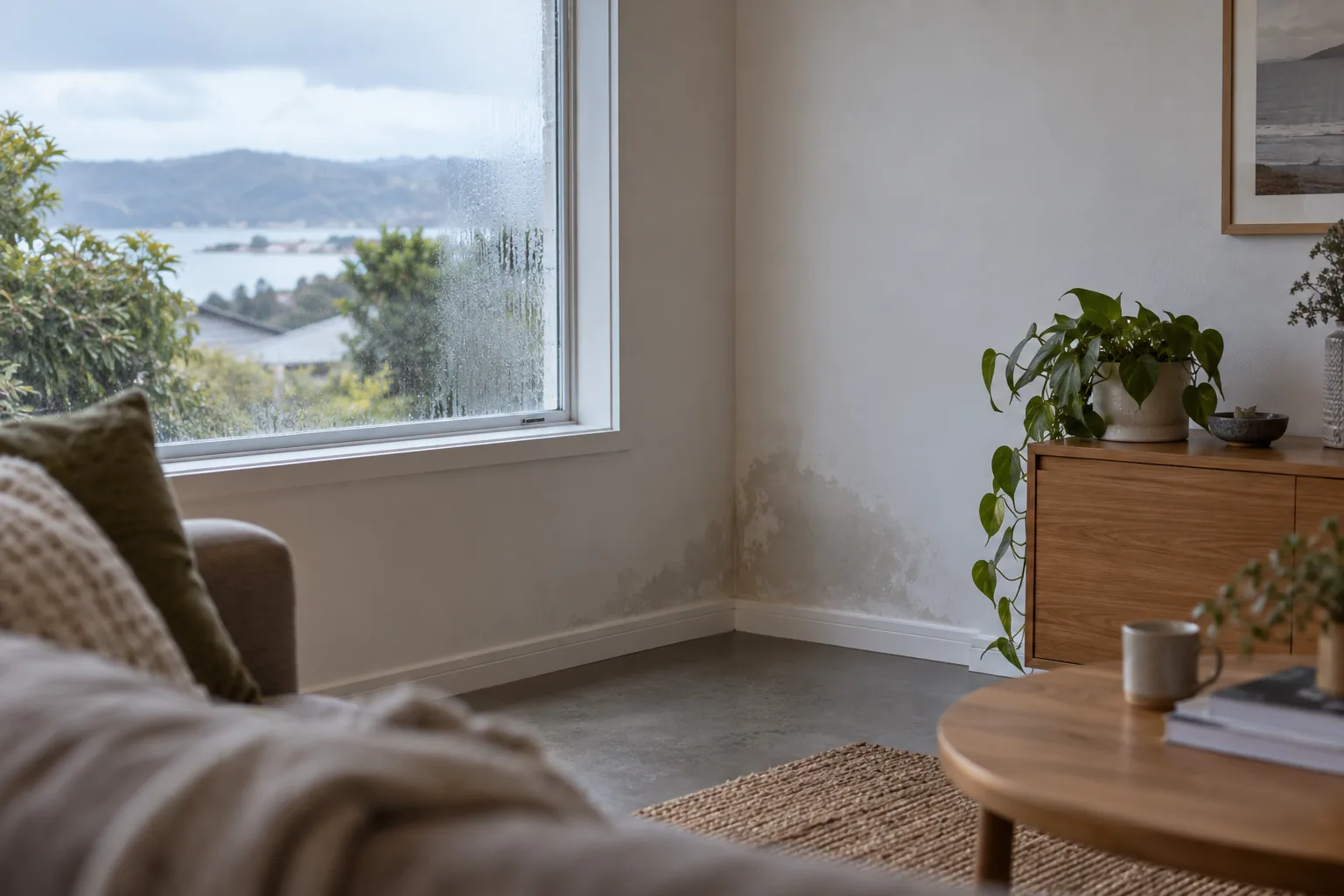
Moisture can arise from everyday activities inside a home, plumbing problems, water entering from outside, damp ground or a combination of conditions. MBIE — Causes and effects of high moisture.
The practical next step is to take the recurring problem seriously, note what you can safely observe and seek appropriate assessment before committing to a repair that may not address the cause.
You do not need to finish a checklist, identify the source yourself or wait for the dampness to return before contacting an appropriate professional.
If water is entering actively, damage appears to be worsening quickly, ceiling linings are sagging, or moisture is near electrical fittings, seek prompt qualified assistance. Avoid disturbing affected building materials or investigating unsafe areas yourself.
This guide helps you organise the facts and questions. It does not diagnose a moisture source or decide whether your home complies with the Building Code.
What are you actually noticing?
Start by separating what you have observed from what you think might explain it.
For example:
| Observation | What it does not establish |
|---|---|
| Water droplets on a bedroom window in the morning | That condensation is the only moisture problem in the room |
| A damp patch below a window | That the window flashing has failed |
| Staining on a ceiling after wet weather | The precise point or route of water entry |
| A musty smell inside a wardrobe | Whether the moisture comes from indoor humidity, the wall or somewhere else |
| Swollen skirting or discoloured wall lining | The full extent or cause of any concealed moisture |
These distinctions matter because visible symptoms can overlap.
MBIE identifies musty smells, staining, swollen materials and changes to linings or flooring among signs that may warrant investigation for weathertightness problems. It also notes that surface mould can have other explanations, including poor ventilation.
Write:
The lower corner of the bedroom wall feels damp again. Staining is visible above the skirting. The same area was affected last winter.
Avoid turning that into an unsupported diagnosis such as:
The exterior wall is leaking because the waterproofing has failed.
The first description can help an assessor. The second may send the investigation in the wrong direction.
Why recurring dampness can have different causes
A damp patch is a symptom, not a reliable way to identify the moisture source.
Several mechanisms may be relevant.
Moisture generated inside the home
Everyday activities such as cooking, showering and drying laundry indoors release moisture into the air.
Where that moisture is not adequately removed, it can contribute to condensation on cooler surfaces.
EECA and MBIE both explain the importance of managing indoor moisture, heating and ventilation.
However, noticing condensation does not prove that a separate damp patch in the same room is caused by condensation.
Plumbing-related water
Leaks from pipes, fittings or other plumbing components can contribute moisture to walls, floors or nearby materials.
The location of a damp patch may raise a question about plumbing, but it does not establish that a pipe is leaking. EECA — Common sources of moisture.
Where plumbing is a credible concern, ask an appropriately licensed plumber to assess the relevant system.
Rainwater entering the building
Water may enter through problems associated with roofing, cladding, windows, flashings or other parts of the building envelope.
The building envelope is the outer construction that helps separate the inside of your home from outdoor weather.
MBIE explains that some weathertightness problems are difficult to identify from visible symptoms alone.
If an existing home repeatedly becomes wet during rain, a suitably qualified building surveyor may be appropriate.
Moisture associated with the ground or subfloor
Ground moisture, site drainage and subfloor conditions can also contribute to dampness.
MBIE identifies moisture entering from damp ground beneath a house as one possible contributor to high indoor moisture levels.
Do not enter confined, unsafe or difficult-to-access subfloor areas simply to complete a homeowner checklist. Have any necessary investigation carried out safely by an appropriate professional.
More than one issue
The same home may have several moisture-related conditions.
For example, ordinary window condensation could coexist with an unrelated plumbing or external-water problem.
That is why the purpose of assessment is to investigate the relevant conditions, not merely to attach a familiar label to the first visible symptom.
What can you safely do while seeking advice?
You do not have to ignore the problem while arranging professional help.
EECA and Health New Zealand provide general healthy-home guidance about reducing avoidable indoor moisture and maintaining appropriate ventilation and warmth.
Where safe and practical, you can continue ordinary household moisture-management habits such as using existing kitchen and bathroom extraction, allowing fresh air into the home and avoiding unnecessary indoor moisture.
But keep two things separate:
- General moisture management can help reduce moisture generated within the home.
- Investigating persistent dampness is about establishing why the particular affected area keeps becoming wet.
One does not replace the other.
Do not assume that buying a dehumidifier, installing a ventilation system, repainting a stained wall or changing insulation will resolve an unidentified moisture source.
Also avoid covering up evidence of ongoing dampness before relevant assessment.
When should you contact a professional?
You do not need to wait until the damage is severe.
Professional assessment is particularly useful when:
- dampness keeps returning or does not clear;
- the affected area is spreading;
- staining, swelling or deterioration is appearing;
- there is a persistent unexplained musty smell;
- moisture appears to be associated with rain;
- an earlier repair has not resolved the problem;
- you cannot establish what is happening;
- you are considering substantial repair or renovation work.
MBIE's weathertightness guidance recommends contacting a building surveyor if you think your home may have weathertightness issues. EECA also identifies registered or accredited building surveyors as relevant professionals for investigating hidden moisture in building materials.
Who might be appropriate?
The right professional depends on the issue being investigated.
| Concern raised by the available information | Professional involvement to consider |
|---|---|
| Unexplained recurring dampness or possible water entry through the building envelope | Appropriately qualified building surveyor with relevant moisture/weathertightness experience |
| Possible pipe, fixture or plumbing-system leak | Appropriately licensed plumber |
| Apparent site-drainage issue | Appropriately licensed drainlayer or other relevant qualified specialist |
| Moisture near electrical installations | Appropriately licensed electrical professional |
| Ventilation or heating performance after underlying causes have been considered | Relevant qualified ventilation, heating or building professional |
This is a contact guide, not a diagnosis or professional-selection decision engine.
If there is an immediate electrical, structural or active-water safety concern, prioritise prompt assistance rather than spending time recording a detailed history.
Health NZ also identifies cold and damp homes as potentially harmful to health. If household members have health concerns, seek advice from an appropriate healthcare professional. Do not use a dampness worksheet to diagnose a health condition. The broad housing-health concern is also supported by the Ministry of Health's Health and Independence Report 2025.
Record the pattern without trying to prove a cause
A short, consistent factual description may help the person assessing the problem.
Useful details include:
- the exact room or area;
- when you first noticed the dampness;
- when it most recently occurred;
- whether it has appeared more than once;
- what you could see, feel or smell without disturbing the building;
- weather or household circumstances you noticed around the same time;
- whether the area changed;
- previous relevant repairs or investigations;
- existing photograph or document references.
Do not assume that a pattern proves causation.
For example:
Damp patch observed beside the lounge window after three days of rain.
does not establish:
Rain has entered through that window.
It gives the assessor a potentially useful observation to investigate.
Similarly, you can note that dampness appeared after showering, that a fan was running, or that a room had been closed for several days without concluding that those circumstances caused the moisture.
You do not need to purchase monitoring equipment or begin a formal measurement programme to use the record.
What if you have already tried something?
Previous action is useful history even if the problem remains.
Record, where known:
- what work or change was made;
- approximately when;
- who carried it out;
- what explanation was provided;
- whether there was a written assessment or report;
- what happened afterward.
A useful description is:
The room was repainted in March. A similar damp patch reappeared in July. No written moisture investigation report is available.
Avoid stating that the previous repair failed because of contractor fault unless that has been established through a separate appropriate process.
If the issue follows recent contracted work, SeekSaver's Renovation Defects NZ guide covers the separate process of recording and raising a possible workmanship or contractual problem.
Useful questions to ask an appropriately qualified professional
You do not have to know the technical answer before asking.
Questions may include:
- What possible moisture sources are relevant to this particular location, and what supports or contradicts each possibility?
- What further inspection or evidence is needed before identifying a likely cause?
- Are there any safety concerns or actions that should be addressed promptly?
- Are any areas concealed or not accessible, and how does that limit the assessment?
- Can you distinguish confirmed findings from possibilities that still need investigation?
- What repair or improvement options follow from the findings, and what remains uncertain?
- Will any proposed work require further design, specialist input or a council/consent check?
- What evidence or follow-up would help establish whether the agreed work has addressed the reported problem?
You do not need to ask every question.
Choose the questions relevant to the actual concern.
Where practical, ask for a written explanation of the assessment's findings, limitations and proposed next steps.
How to think about repairs after assessment
Once the relevant problem has been assessed, separate three things:
- The identified issue: what the professional says the evidence supports.
- The proposed action: what work or improvement they recommend.
- The limits of that recommendation: any areas that remain uncertain, assumptions made or further checks needed.
A recommendation to improve ventilation, for example, should not automatically be treated as confirmation that no plumbing or weathertightness problem exists.
Likewise, a recommendation to repair a leak does not by itself establish that every moisture problem in the home will disappear.
Ask the professional to explain how the proposed work relates to the findings.
Where work may involve building consent, use SeekSaver's Building Consent for Renovations NZ guide for the separate question of checking consent requirements. Do not use this dampness guide to decide whether work is exempt.
If professional findings establish a repair-project scope, the Home Renovation Project Brief Checklist NZ can help organise the wider project. When considering a builder for defined work, Questions to Ask a Builder Before a Renovation NZ supports that later conversation—not moisture diagnosis.
What if the dampness returns?
If a damp patch reappears after assessment or repair, retain the previous report and record the new observation.
Note:
- when it returned;
- where;
- whether it appears similar or different;
- any relevant observed circumstances;
- who has been told;
- what response or additional assessment is proposed.
Do not automatically conclude that the first professional was wrong, that a contractor caused the problem or that the next repair will work.
Return to the documented facts and obtain appropriate follow-up.
A note about Healthy Homes Standards
New Zealand's Healthy Homes Standards set minimum requirements for qualifying residential rental properties, including heating, insulation, ventilation and moisture-related matters. Tenancy Services — Healthy homes standards.
They are not a universal certification checklist for every owner-occupied existing house.
This guide does not determine Healthy Homes Standards compliance or Building Code compliance.
If the property is rented, the applicable tenancy requirements are a separate issue.
Home Moisture Observation & Professional Questions Record
If you find it useful, the printable record below can help you keep observations, professional questions and later advice together.
It is optional.
You can contact a professional immediately, with no completed record.
The record is not a moisture diagnosis, safety check, building assessment, HomeFit certificate or compliance document.