
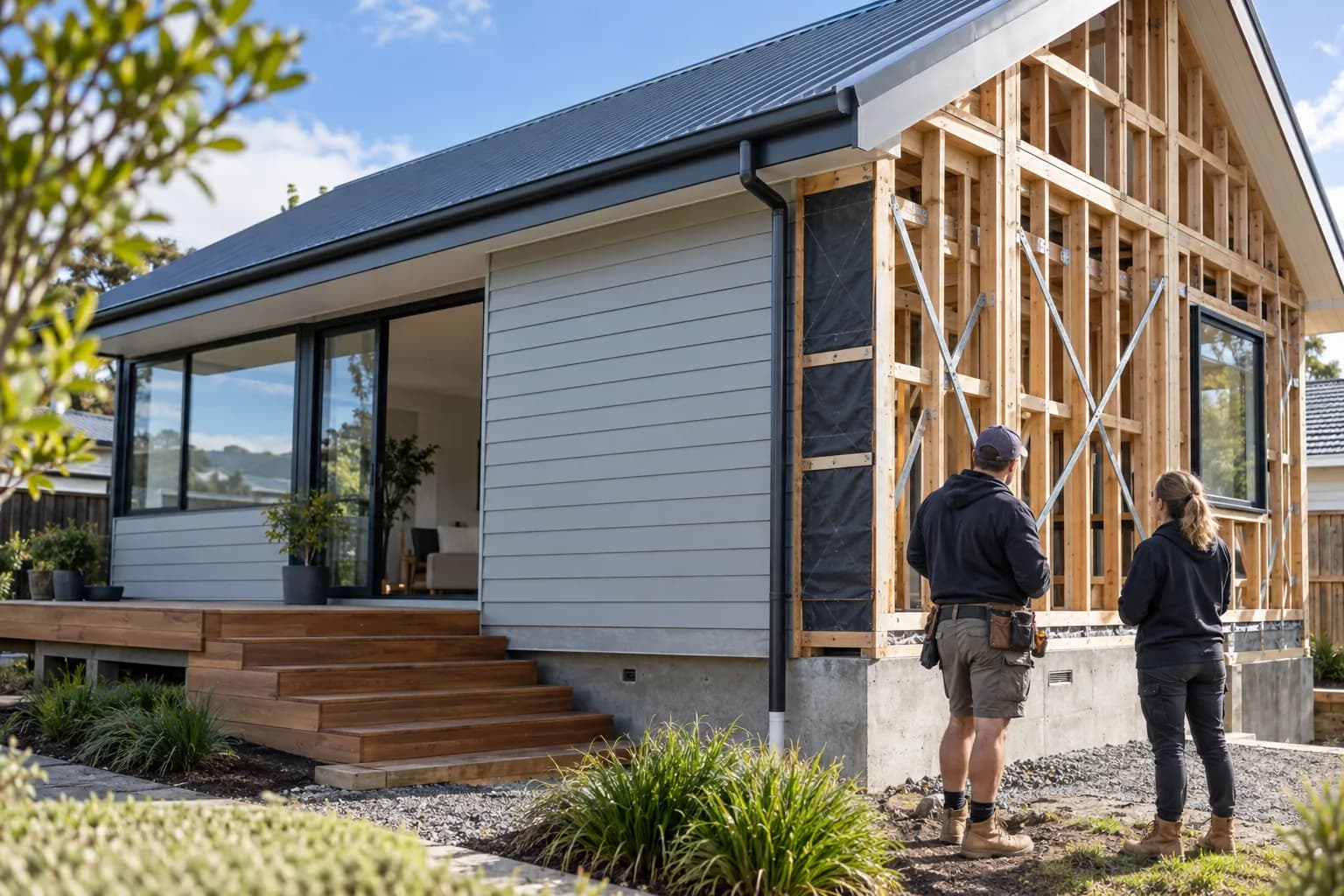
If your renovation affects the structure or weathertightness of a home, you may hear the term Restricted Building Work, or RBW.
That does not mean every renovation is RBW.
It also does not mean every person with an LBP licence can do every kind of restricted work.
The practical homeowner questions are:
Does this part of my project raise an RBW question?
If it does, what practitioner or professional role is needed?
Does that person hold the right current licence or authorisation for this work?
Which Certificate or Record of Work should I expect and keep?
SeekSaver cannot legally classify your particular building work.
Use the current Building Act and RBW Order, your project designer/BCA records and appropriately qualified advice where the position is uncertain.
Jump to the Restricted Building Work & LBP Project Record
What Restricted Building Work actually means
RBW is a legal category of residential building and design work.
The current RBW Order covers defined work involving matters such as:
- a home's primary structure;
- its external moisture-management system;
- certain fire-safety design for small-to-medium apartment buildings. (Legislation New Zealand)
Primary structure includes building elements intended to resist vertical or horizontal loads, such as foundations, subfloor framing, beams, bracing, columns, roofs and walls. (Legislation New Zealand)
For construction work, the Order also identifies specific classes of work such as:
- carpentry;
- roofing;
- bricklaying/blocklaying;
- external plastering;
- foundations. (Legislation New Zealand)
The legal test therefore depends on the actual work, building type and current statutory definition—not merely whether someone calls a project “structural work” or a “major renovation”.
Building consent and RBW are related, but not the same question
Do not assume:
“Building consent required = all work is RBW.”
That is not correct.
A consented renovation can contain:
- RBW;
- non-RBW;
- specialist regulated work that belongs to another licensing regime.
Current MBIE guidance gives examples of consented activities that can sit outside the RBW definition. (Building.govt.nz)
Likewise, ordinary low-risk work carried out under Schedule 1 exemptions is generally outside the RBW regime.
But there is an important 2026 exception for qualifying non-consented small stand-alone dwellings, which have their own RBW/licensed-professional rules.
If your main question is still:
“Does my renovation need building consent?”
use SeekSaver's Building Consent for Renovations NZ first.
Ask which part of the project may be RBW
Instead of asking only:
“Is this renovation RBW?”
break the question down by work component.
For example:
- Does the work affect primary structure?
- Does it alter an external moisture-management system?
- Is restricted design work involved?
- For a small-to-medium apartment building, is relevant fire-safety design involved?
- Is the construction work within a trade category covered by the current RBW Order?
- Is this a 2026 non-consented small stand-alone dwelling?
Then identify the source of the answer:
- designer/project documentation;
- building-consent material;
- BCA/council information;
- current legislation/guidance;
- suitably qualified professional advice.
If you still cannot establish the position confidently, record:
Needs clarification
rather than turning SeekSaver into an RBW classifier.
Restricted Building Work needs the right licence — not just any LBP
Current law requires RBW to be carried out or supervised by someone appropriately licensed for that kind of work, unless a statutory exception applies. (Legislation New Zealand)
The LBP scheme has seven licence classes:
- Design;
- Carpentry;
- Roofing;
- Bricklaying and blocklaying;
- External plastering;
- Foundations;
- Site. (Licensed Building Practitioners)
The important homeowner rule is:
Check the licence class against the actual RBW responsibility.
Do not simply ask:
“Are you an LBP?”
A practitioner can be licensed while still not holding the licence class needed for the work you want them to carry out or supervise.
A Site licence does not let someone supervise all RBW
The Site licence causes particular confusion.
A Site LBP has skills in coordinating and overseeing construction.
But current MBIE/LBP guidance says a Site licence by itself does not allow the holder to supervise or sign off RBW, and Site LBPs cannot issue Certificates or Records of Work merely on the basis of that Site licence. (Building.govt.nz)
So if someone says:
“I have a Site licence, so I can sign off all the restricted work.”
check the relevant trade/design licensing position instead of relying on that statement.
Design work has its own licensing requirements
Restricted design work must be carried out or supervised by an appropriately authorised design professional.
Depending on the work, this may include:
- an LBP holding the appropriate Design licence;
- a New Zealand registered architect;
- a chartered professional engineer where the statutory framework recognises that role. (Licensed Building Practitioners)
The correct professional depends on what is actually being designed.
Do not use a general job title as proof that someone can take responsibility for every restricted design component.
Plumbing, gasfitting, drainlaying and electrical work are separate
Do not treat an LBP licence as a replacement for the specialist licensing rules that apply to these trades.
Most plumbing, gasfitting and electrical work has separate regulated-professional requirements. (Building.govt.nz)
There are limited situations where another regulated professional may also be treated as appropriately licensed for defined RBW within their professional work, but that does not turn the specialist occupation into a general LBP licence.
For this article, the safe rule is:
Check the licensing regime that applies to the actual work.
Detailed trade licensing belongs outside this resource.
Check the LBP Public Register before relying on a licence
The Public Register is the practical homeowner verification step.
You can:
- ask the practitioner for their current LBP ID;
- scan the licence QR code;
- search their details on the Public Register;
- check the licence class shown. (Licensed Building Practitioners)
Record:
- practitioner name;
- licence number;
- licence class;
- register-check date;
- current status shown when checked;
- project work they are expected to carry out or supervise.
Do not assume:
“They appeared on the register once, so their status can never change.”
LBPs relicense and their current licence status matters. (Licensed Building Practitioners)
Also do not assume that being an LBP in one class makes the practitioner licensed for every kind of RBW.
Tell the BCA who is doing the RBW on a consented project
For RBW carried out under a building consent, the homeowner has notification responsibilities.
Before RBW starts, section 87 requires the owner to give the BCA the names of engaged LBPs that were not already identified in the consent application.
If practitioners change after RBW begins, the BCA must also be notified as required by section 87. (Legislation New Zealand)
Your builder or project manager may handle practical communication, depending on your arrangement.
But do not assume a contractual delegation removes the owner's statutory responsibility.
Keep:
- practitioner;
- role;
- licence information;
- BCA notification/reference;
- date;
- any later change.
Certificate of Design Work: record who took responsibility for RBW design
A Certificate of Design Work, commonly called a CoW, records the restricted design work carried out or supervised by the relevant design professional.
The current prescribed Form 2A asks the practitioner to identify the RBW design, relevant plans/specifications and whether they carried out or supervised the design. (Building.govt.nz)
For a normal building-consent project, the Certificate of Design Work forms part of the building-consent application where RBW design is involved. (Licensed Building Practitioners)
Record:
- practitioner;
- professional/licensing basis;
- form/reference/date;
- design work covered;
- plans/specifications referenced;
- submitted/provided status;
- storage location.
Do not confuse the Certificate of Design Work with approval
It is not:
- the building consent;
- a council/BCA approval;
- a CCC;
- certification of every part of the project.
The BCA still makes its own consent decision. (Licensed Building Practitioners)
Record of Building Work: record who carried out or supervised the RBW
At completion of their consented RBW, each relevant LBP must provide the prescribed Record of Building Work stating what RBW they carried out or supervised. (Legislation New Zealand)
Current Form 6A records matters such as:
- project/consent reference;
- practitioner;
- type of RBW;
- description;
- whether the practitioner carried it out or supervised it. (Building.govt.nz)
MBIE says the relevant Records of Building Work are later supplied through the council process and are important project records. (Building.govt.nz)
If an LBP leaves part-way through
Do not wait until the entire project is finished and hope one replacement practitioner signs for everything.
Current MBIE guidance says the departing LBP should provide a Record of Building Work covering the RBW they completed, while the new LBP records their own subsequent work. (Building.govt.nz)
What a Record of Building Work does not mean
It is not:
- an inspection approval;
- the project's CCC;
- proof that the whole project is compliant;
- an automatic guarantee of workmanship.
It records the practitioner's RBW responsibility.
Owner-builder exemption: a narrow statutory exception
New Zealand retains an owner-builder pathway for some RBW on a person's own home.
Under the current Building Act, the owner-builder criteria include that the person:
- has a relevant interest in the land/building;
- lives or intends to live in the household unit;
- personally carries out the RBW, possibly with unpaid friends or family;
- has not used the exemption on a different household unit during the previous three years. (Legislation New Zealand)
A qualifying owner-builder can carry out the relevant RBW without LBP supervision, but the building-consent and Building Code obligations still apply. (Building.govt.nz)
The process involves statutory owner-builder documentation and council/BCA notices where applicable. Current Form 2B is the owner-builder statutory declaration. (Building.govt.nz)
Specialist work is still separate
The owner-builder exemption does not turn the homeowner into a licensed:
- plumber;
- gasfitter;
- drainlayer;
- electrical worker.
Those statutory trade requirements remain. (Building.govt.nz)
SeekSaver does not determine eligibility
Do not use this article as a test saying:
“You qualify.”
If you are considering the owner-builder exemption, verify the current statutory criteria and council/BCA process.
Important 2026 exception: the granny-flat pathway
The 2026 small stand-alone dwelling rules changed one important part of RBW.
A qualifying small stand-alone dwelling can use the special building-consent exemption, but defined work on that dwelling can still be RBW. Current section 401B and the RBW Order expressly accommodate that exception. (Legislation New Zealand)
That is different from ordinary Schedule 1 exempt work.
Do not say “all granny-flat work is RBW”
Instead, check the specific work under the current Act, RBW Order and Schedule 1A framework.
For the relevant RBW:
- design records are required through the current certificate-of-work process; (Legislation New Zealand)
- LBPs carrying out/supervising RBW must provide Records of Work; (Legislation New Zealand)
- those Records of Work feed the special territorial-authority record process; (Legislation New Zealand)
- the ordinary owner-builder exemption does not apply to this non-consented small stand-alone dwelling pathway. (Legislation New Zealand)
Full granny-flat exemption eligibility and completion procedure belong in the dedicated current MBIE guidance, not this article.
Keep the RBW records with the project
RBW records matter beyond the immediate stage at which they are created.
Keep, where applicable:
- practitioner names and licence information;
- register-check evidence/date;
- Certificate(s) of Design Work;
- Records of Building Work;
- relevant BCA/council notices;
- project changes affecting practitioner responsibility;
- owner-builder declaration/notice records where applicable;
- current approved project documents.
For consented work, Records of Building Work can later be relevant to the CCC process.
SeekSaver's Code Compliance Certificate NZ resource owns the final-sign-off workflow.
For long-term close-out and wider documents, use Renovation Handover Checklist NZ.